Van
The Deer KingVan is the last surviving leader of the Lone Antlers, a warrior band that resisted the Zolian invasion, and a former slave who escapes the Aquafa salt mine. His story turns survival into responsibility: after discovering Yuna hidden among the dead, he carries her from the mine and gradually makes a home with the Oki people. His renowned hunting skill and his instinct to stand between danger and vulnerable life persist, but their meaning changes from resistance to care.
Identity and Background
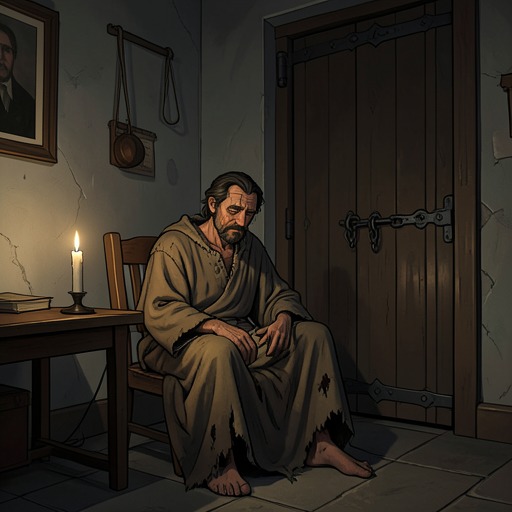
Van is identified as the sole survivor of the Lone Antlers, a band of warriors who fought the Zolian invasion before he was captured and enslaved in the salt mine. In the slave records, a Zolian officer finds his name listed as Van of the Gansa clan; elsewhere he is called Lone Antler Van or Broken Antler Van. These names place him at the crossing of two histories: the military defeat of his people and the imperial system that reduced him to a numbered prisoner.
The name Head Snatcher has a different origin. Tohlim tells Hohsalle that Van was known by that name, then explains that it comes from a term used in falcon hunting, not from beheading victims. The distinction matters: the frightening nickname does not describe a history of executions. It draws instead on the specialized language of hunting, a practice that runs through Van’s life and becomes a means of understanding him more accurately than rumor does.
The Lone Antlers had sought death rather than life, in Tohlim’s account, but Van remains alive when the rest of the band is gone. He is not presented as untouched by that history: he is a fugitive, aware that he may have to leave the people who have taken him in. Yet the life he makes after the mine depends on what his past has taught him—how to read animals and terrain, how to act decisively in danger, and how to protect those who cannot protect themselves.
Escape and the Child in the Oven
In the salt mine, Van discovers that the child’s mother died trying to keep her back against an oven and guard what was inside from the beasts. He gently moves her body away from the opening. The child looks up at him with tearstained cheeks, clutching a crust of fahmu in one fist. The smallness and ordinariness of that food, set against the dead surrounding the oven, makes the child’s survival concrete rather than miraculous in the abstract: someone had spent her final effort keeping her alive.
When Van bathes the girl, he sees a long, thin, scabbed scratch beneath her left ankle and recognizes that she, too, has been grazed by fangs. He compares the mark with the scab on his own arm and understands that both are survivors of an attack that killed dozens of people in the mine. He murmurs, “Another survivor, are you?” The words register the extraordinary fact of their survival, but the gesture that follows is more important: he washes her, wraps her in a soft cloth, and makes a makeshift bed for her.
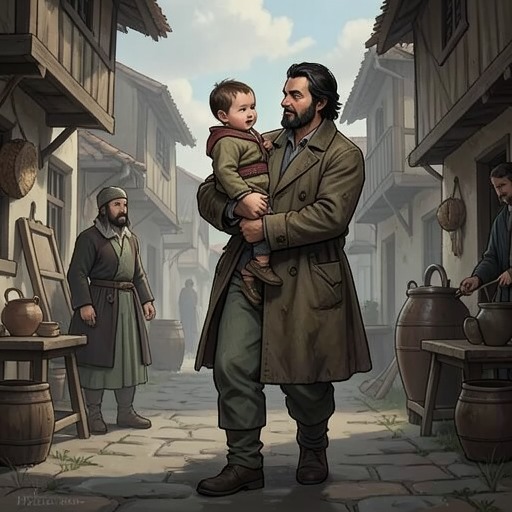
The child falls asleep sucking her thumb in Van’s arms. Around them, the mine’s living and dead recede into shadow; the warmth of the sleeping girl is what confirms that life remains. Van’s rescue of Yuna thus begins not with a declaration or a plan but with care for a child he has just found. His escape from the mine becomes an obligation to bring another survivor with him.
A New Life Among the Oki People
Van meets Tohma in the forest near the salt mine. When Tohma asks for his help with Tsupi, a pyuika who may be carrying young, Van agrees to join the Oki household. Tohma introduces himself as Tohma of the Oki clan and offers his hand; Van accepts it and gives his own name. Their meeting creates a path out of flight and into a community where Van’s knowledge has a practical use.
Almost two months later, Van and Tohma have reached the Oki people’s winter home in a valley in the Oki region, on Aquafa’s northern edge. They arrive before the first snowfall. The seasonal move is shaped by the reindeer herders’ needs: the valley is sheltered from heavy snow, but the slow-growing lichens their animals eat take years to return, so the people winter in a different place each year. Van understands this against the experience of his own people, whose pyuika grazing plants grow back quickly enough for them to return to familiar grounds each season.
Van contributes to the household through hunting and winter preparation. He returns with game, helps secure food, and recognizes that his skill can ease the family’s shortage. When spring comes, the household will face taxes on its reindeer livelihood; successful pyuika breeding could help reduce that burden. Van’s ability to help with Tsupi’s delivery therefore matters alongside the meat he brings home: his presence may support both the herd’s future and the family’s chance of making a living.
The family welcomes him without pressing him to explain his past. Van senses that they know he has one, and suspects they may avoid asking because they fear he would leave if they did. He remains a fugitive, with no certainty about when or how he may have to go, so he works to repay the family in whatever ways he can. Helping them raise pyuika becomes, for him, more than a debt repaid. Being near the animals lifts his heart and reminds him that he remains a Pyuika Rider deep down.
Names, Bonds, and Protection
Van’s relationship with Yuna develops through repeated acts of tenderness rather than blood ties. He imagines her greeting him when he enters the tent, calling him “Ochan” and tottering into his arms. Although she is learning words, he deliberately does not correct her to the form other children use for father. The endearment belongs to their own relationship, and Van values it as it is.
The fatherhood implicit in that bond is set against Van’s losses and uncertainties. The Lone Antlers were men who had lost their families, yet sang of protecting those who depended on them. When Van recalls their song, he sees Yuna sleeping with her thumb in her mouth and understands her as his child, though she was not born of his blood. She is more precious to him than life. The song’s image of a fawn sheltered behind its protector gives his present attachment a language rooted in the people he lost, without making Yuna merely a replacement for them.
His place in the Oki household also rests on an unspoken accommodation. The family gives shelter without demanding disclosure, while Van repays their trust through work and the knowledge he brings. His need to remain watchful as an escaped slave does not cancel his growing attachment; it sharpens the contrast between a life that might still be taken from him and the ordinary responsibilities he chooses to accept.
The Black Beasts and Van’s Change
When black beasts approach the Oki camp, Van senses their arrival before they reach his tent. Holding a child, he feels fear and excitement together and perceives the pyuika’s panic at the enclosure, as well as the tied hunting dogs’ ceaseless cries. The danger is directed at the herd. Van reads the attack as a coordinated hunt: some beasts drive the pyuika toward one side of the enclosure while another circles behind, crouched to spring over the fence.
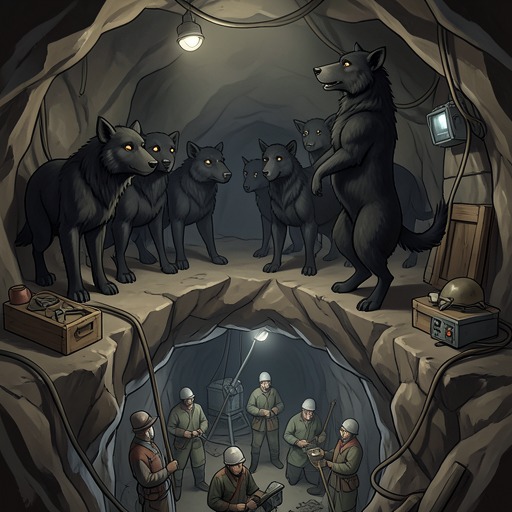
He sees the hunter’s trajectory before it jumps and charges from the side, as a buck might defend its herd against wolves. In that instant, Van’s perception and the animals’ fear converge. The beasts’ eyes recall those that attacked the salt mine, where the victims were bitten one by one. He had suspected that they acted like soldiers; now he understands that the creature is not simply wild but has moved with a pack under the direction of a person holding its reins.
The confrontation also makes Van confront the mystery of his own survival. He was bitten by one of these creatures, dreamed afterward, and then found that his body had changed; he was not the only person to survive a bite. Yet the strongest remnant of the encounter is not fear or regret. It is a warm, almost nostalgic bond he felt when his eyes met the beast’s. The connection troubles him rather than explaining itself, leaving his altered condition and the relationship between the creatures and their human controller unresolved in these scenes.
Van’s response to the attack grows from the same protective impulse that first moved him to lift Yuna from the oven. At the mine, he finds a child whom another person died trying to shield; in the Oki camp, he puts himself between a predator and the pyuika. The pattern does not erase the violence done to him or the people he has lost. It shows instead what he chooses to do with survival: stand guard over life that is exposed to danger.
Narrative Significance
Van’s names and roles trace a change in what survival means. He is a defeated warrior, an enslaved man identified in official records, a fugitive, a hunter called Head Snatcher, and finally a protector within a community that accepts his labor without requiring his history. None of these identities wholly replaces the others. The fugitive still works to repay the Oki family; the former Pyuika Rider finds renewed purpose in helping with the animals; the survivor of the mine becomes responsible for Yuna.
His care also offers a counterpoint to the stories people tell about disease and divine punishment. As a child, Van believed villagers’ explanations that sickness followed offenses against gods, but the rumor and ritual now make him angry. He does not believe the black beasts were sent by gods, and instead remembers how people invoke the divine to explain what they already want to think. His memories of his son and Yuna’s dependence give the question of responsibility a personal weight: explanations cannot substitute for protecting the living.
The image that most clearly gathers Van’s arc is the sleeping child in his arms. He has survived an invasion, enslavement, and the slaughter in the mine, but the defining measure of his survival is not endurance alone. It is that he carries Yuna out, accepts a place among the Oki people, and repeatedly turns toward the vulnerable when danger comes. The story makes his continued life an ongoing act of sheltering others.